  |
|
 HomePicturesTechnicalTournamentRecreationalFieldsStores HomePicturesTechnicalTournamentRecreationalFieldsStores |
|
|
Beginner InfoNews
And ArticlesLinksResourcesVideoContact
UsSearch |
| |
|
|
HomePicturesTechnicalTournamentRecreationalFieldsStores |
|
|
Beginner InfoNews
And ArticlesLinksResourcesVideoContact
UsSearch |

What
do you think?
|

WARPIG Ballistic Labs: Revolution X-Board and Polycarbonate body testing by Bill Mills August 2001 In the summer of 2001, ViewLoader, a division of Brass Eagle, introduced two new changes for the Revolution loader, a new polycarbonate body, and the X-Board. X-Board
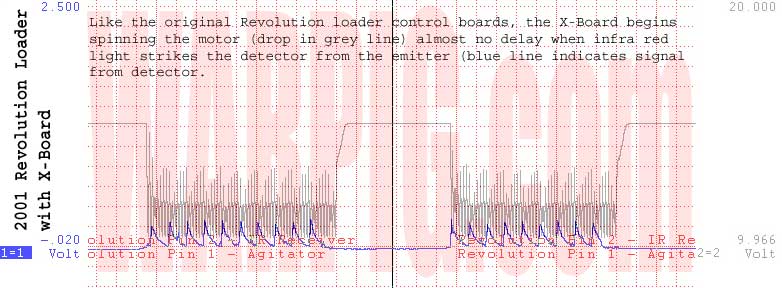
The drawback to the upgrade was that it caused a delay between the time that a ball jam created a gap in the stack of balls in the feed neck, and the time the agitating paddles began to spin. This delay, which averaged 0.162 seconds in a WARPIG Ballistic Labs test could cause problems with continuous rapid fire. Click HERE to see the results of that test.
Users of the X-Board at the International Amateur Open reported improved performance on the field, but was the how much of a difference was there? To compare hard data, the X-Board was connected to the same test equipment used in the original WARPIG Ballistic Labs Revolution time test. The X-Board performed as it was designed. The motor activates just as a signal change is detected from the infrared detector. Click the graph below to see the results of the X-Board test.
Unlike the original Revolution board however, the pulsed IR signal used by the X-Board allows the electronics to discriminate between an empty feed neck, and sunlight striking the detector. A practical test, turning on the loader, blocking the feed neck with a finger, and exposing the loader to sunlight from various angles. The sunlight did not trigger the Revolution's agitator. Polycarbonate body
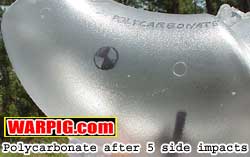
Typical breakage of the Revolution loader occurs from paintball impact on the field, or the feedneck breaking. In order to test impact resistance, a test stand was configured with a weighted pendulum set to deliver a strike with a consistent force against a loader either vise mounted, for strikes on the loader front, or standing on the floor, backed up by a solid surface.
After initial set up and testing (which destroyed the body of a well used Revolution in determining what kind of force was needed to break a Revy) the two rest samples were prepared. They were marked with target points, and labeled to avoid confusion as they were both "clear." When seen side by side, it is apparent that the polycarbonate body is more transparent than the plastic. As sunlight and physical stress can weaken plastics, an unused clear Revolution loader was used to compare to the polycarbonate model. Having seen broken Revolution loaders
coming off the field, it appears that the front of the loader is the most
common area for impact damage in Revolution loaders. This idea makes
sense in that the flat shape would not provide as much structural integrity
as the curved areas, but also because in a game the front is the mist likely
area to get shot.
Conclusion
Click Here to see how the X-Board compares to other loaders in the WARPIG Ballistic Labs Loader Speed Comparison.
|
| Copyright © 1992-2019
Corinthian Media Services. WARPIG's webmasters can be reached through our feedback form. All articles and images are copyrighted and may not be redistributed without the written permission of their original creators and Corinthian Media Services. The WARPIG paintball page is a collection of information and pointers to sources from around the internet and other locations. As such, Corinthian Media Services makes no claims to the trustworthiness or reliability of said information. The information contained in, and referenced by WARPIG, should not be used as a substitute for safety information from trained professionals in the paintball industry. |
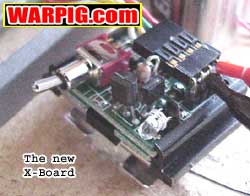 As
of August 2001, all newly manufactured Revolution loaders include the X-Board,
and the X-Board is available through paintball stores as an upgrade for
existing Revolutions. A previous upgrade to the Revolution electronics
prevented problems with sunlight interfering with the infrared sensor in
the feed neck.
As
of August 2001, all newly manufactured Revolution loaders include the X-Board,
and the X-Board is available through paintball stores as an upgrade for
existing Revolutions. A previous upgrade to the Revolution electronics
prevented problems with sunlight interfering with the infrared sensor in
the feed neck.
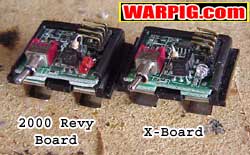 The
X-Board can be identified in a side by side comparison with the 2000 board.
The X-Board has a clear (though it illuminates red) low power LED, while
the older board features a red plastic LED.
The
X-Board can be identified in a side by side comparison with the 2000 board.
The X-Board has a clear (though it illuminates red) low power LED, while
the older board features a red plastic LED.
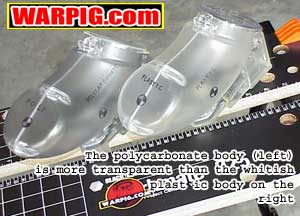 Also
new for the ViewLoader is a polycarbonate body, rather than the inexpensive
plastic that has been used for the last several years. Polycarbonate is
an extremely strong and resilient material, it is used regularly in the
manufacture of paintball goggle lenses. The replacement bodies and
new Revolutions will be produced with polycarbonate in the fall of 2001.
Approximately 35 first run bodies had been produced in early August, and
a sample was provided for WARPIG Ballistic Labs destructive testing.
Also
new for the ViewLoader is a polycarbonate body, rather than the inexpensive
plastic that has been used for the last several years. Polycarbonate is
an extremely strong and resilient material, it is used regularly in the
manufacture of paintball goggle lenses. The replacement bodies and
new Revolutions will be produced with polycarbonate in the fall of 2001.
Approximately 35 first run bodies had been produced in early August, and
a sample was provided for WARPIG Ballistic Labs destructive testing.
 The
pendulum was constructed from a typical claw hammer, suspended from a length
of nylon rope. There are two very convenient attributes to gravity
that make it an attractive power source for this sort of test. First,
gravity is consistent. Time after time, as the hammer is dropped
from the same height, gravity will accelerate it with the same amount of
force each time. The second is, that it is freely available, making
the pendulum simple to set up. The length of the pendulum was six
feet and six inches. The hammer was raised to the height of the pivot
point to allow a 90 degree swing for each strike. A small shop rag
was attached to the claw of the hammer to provide air resistance, similar
to the tail of a kite, and insure that the hammer would face the proper
direction when it struck the test targets.
The
pendulum was constructed from a typical claw hammer, suspended from a length
of nylon rope. There are two very convenient attributes to gravity
that make it an attractive power source for this sort of test. First,
gravity is consistent. Time after time, as the hammer is dropped
from the same height, gravity will accelerate it with the same amount of
force each time. The second is, that it is freely available, making
the pendulum simple to set up. The length of the pendulum was six
feet and six inches. The hammer was raised to the height of the pivot
point to allow a 90 degree swing for each strike. A small shop rag
was attached to the claw of the hammer to provide air resistance, similar
to the tail of a kite, and insure that the hammer would face the proper
direction when it struck the test targets.



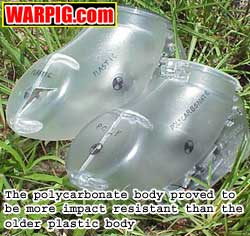 Both
of the new changes to the Revolution loader were shown in testing to be
marked improvements - the faster response time of the X-Board, and the
increased strength of the polycarbonate body.
Both
of the new changes to the Revolution loader were shown in testing to be
marked improvements - the faster response time of the X-Board, and the
increased strength of the polycarbonate body.