  |
|
 HomePicturesTechnicalTournamentRecreationalFieldsStores HomePicturesTechnicalTournamentRecreationalFieldsStores |
|
|
Beginner InfoNews
And ArticlesLinksResourcesVideoContact
UsSearch |
| |
|
|
HomePicturesTechnicalTournamentRecreationalFieldsStores |
|
|
Beginner InfoNews
And ArticlesLinksResourcesVideoContact
UsSearch |
What
do you think?
|
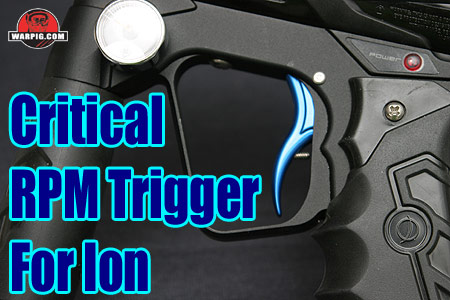
RPM Trigger for Ion By Bill Mills - Jan 2006 The trigger defines much of how a paintgun feels to a player, and for many players the stock trigger just won’t do. Critical Paintball has produced the RPM Trigger for the Ion.
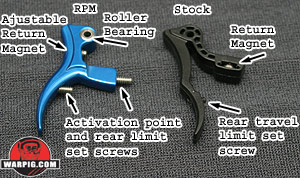
With its new magnets in place, the Ion’s electronics went back inside the grip frame, and the ‘gun was reassembled. Next came adjustment. With three adjustment points accessible when the Ion is fully assembled, the RPM makes it easier to tweak the trigger pull. At the top of the trigger is the trigger return magnet. Screwing this further into the trigger provides more physical resistance, via the magnets, to return the trigger to the forward position. In the middle of the trigger is a screw to adjust the trigger’s activation point – how far into the trigger pull the Ion’s microswitch is activated to fire a shot. The lower most screw adjusts the rear travel limit, or ultimately how long the Ion’s total trigger pull length is.
With the right tools it was easy to adjust and test to get the RPM trigger down to a pull that was under 2mm measured at the bottom of the trigger, and which was responsive and easy to shoot quickly. While it adjusted to even shorter pulls reliably, the final adjustment gave a comfortable feel for faster shooting. Critical Paintball’s RPM Trigger provides
a stylish roller bearing trigger pull while allowing easy external four-point
trigger pull adjustment for the Ion.
|
| Copyright © 1992-2019
Corinthian Media Services. WARPIG's webmasters can be reached through our feedback form. All articles and images are copyrighted and may not be redistributed without the written permission of their original creators and Corinthian Media Services. The WARPIG paintball page is a collection of information and pointers to sources from around the internet and other locations. As such, Corinthian Media Services makes no claims to the trustworthiness or reliability of said information. The information contained in, and referenced by WARPIG, should not be used as a substitute for safety information from trained professionals in the paintball industry. |
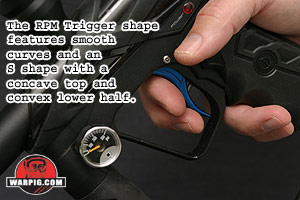 The
RPM trigger uses an S shape, rather than a traditional double concave two
finger trigger shape. Overall the trigger features smooth curves
and a generous width. For many players this shape is popular as it
lines up well with a pair of fingers that are angled slightly downward
when gripping the paintgun. Critical also adds a roller bearing to
their design for fast, smooth action, and the Critical Pro Pin – a threaded
trigger pivot pin to replace the stock friction fit pin.
The
RPM trigger uses an S shape, rather than a traditional double concave two
finger trigger shape. Overall the trigger features smooth curves
and a generous width. For many players this shape is popular as it
lines up well with a pair of fingers that are angled slightly downward
when gripping the paintgun. Critical also adds a roller bearing to
their design for fast, smooth action, and the Critical Pro Pin – a threaded
trigger pivot pin to replace the stock friction fit pin.
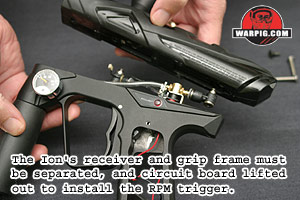 Installing
the RPM trigger involved a little more effort than most common trigger
swaps, but was not unusually difficult. The first steps were removing
the Ion’s trigger frame and disconnecting the banjo bolts from its receiver
(See
Installing
the RPM trigger involved a little more effort than most common trigger
swaps, but was not unusually difficult. The first steps were removing
the Ion’s trigger frame and disconnecting the banjo bolts from its receiver
(See 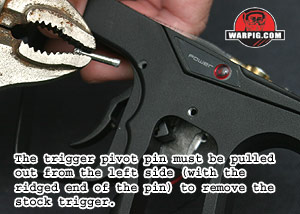 With
the receiver apart from the grip frame, a punch and hammer were used to
tap the stock trigger pivot pin out of the left side of the grip frame.
Once the pin was clear enough from the grip frame, a pair of pliers were
used to completely remove it. This allowed the trigger to be lifted
out of the grip frame, and the RPM trigger to be dropped in its place.
With
the receiver apart from the grip frame, a punch and hammer were used to
tap the stock trigger pivot pin out of the left side of the grip frame.
Once the pin was clear enough from the grip frame, a pair of pliers were
used to completely remove it. This allowed the trigger to be lifted
out of the grip frame, and the RPM trigger to be dropped in its place.
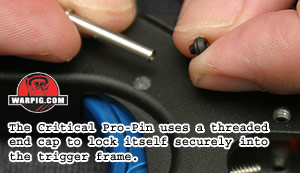 The
Critical Pro Pin slid through the grip frame and trigger, and its threaded
end cap screwed into the other end. A tiny o-ring on the end cap
acted as a lock washer, to keep the small screw from vibrating loose.
This arrangement – which looks much like a tongue piercing barbell – has
an advantage over the stock pin in that it positively locks in place, and
won’t work its way loose from being removed and reinstalled several regularly
(most users who rarely if never change their triggers are unlikely to see
a problem with the friction fit stock pin.)
The
Critical Pro Pin slid through the grip frame and trigger, and its threaded
end cap screwed into the other end. A tiny o-ring on the end cap
acted as a lock washer, to keep the small screw from vibrating loose.
This arrangement – which looks much like a tongue piercing barbell – has
an advantage over the stock pin in that it positively locks in place, and
won’t work its way loose from being removed and reinstalled several regularly
(most users who rarely if never change their triggers are unlikely to see
a problem with the friction fit stock pin.)
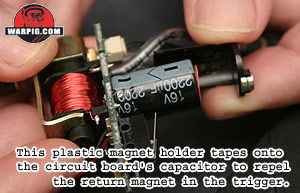 In
order to provide more adjustability, the RPM’s trigger return magnet is
in a different location than that of the stock Ion trigger. To give
it an internal magnet to repel, Critical includes a pair of tiny magnets
in a plastic shell carrier. The carrier adheres to the Ion’s capacitor
with a tiny spot of double stick tape.
In
order to provide more adjustability, the RPM’s trigger return magnet is
in a different location than that of the stock Ion trigger. To give
it an internal magnet to repel, Critical includes a pair of tiny magnets
in a plastic shell carrier. The carrier adheres to the Ion’s capacitor
with a tiny spot of double stick tape.
 After
an installation that took less than five minutes, adjusting didn’t take
long, but was not as easy as expected. The head of the trigger activation
adjustment screw was so deep in the trigger that the short end of a standard
hex wrench could not reach it, but the trigger guard got in the way of
the long end. With one that was too long, and one too short, a little
hunting through the tool box found a shorter hex wrench that was “just
right” to do the job. The RPM trigger’s three adjustment points
combined with the forward travel limit screw in the bottom of the trigger
guard to provide full four point adjustment without having to take the
Ion apart.
After
an installation that took less than five minutes, adjusting didn’t take
long, but was not as easy as expected. The head of the trigger activation
adjustment screw was so deep in the trigger that the short end of a standard
hex wrench could not reach it, but the trigger guard got in the way of
the long end. With one that was too long, and one too short, a little
hunting through the tool box found a shorter hex wrench that was “just
right” to do the job. The RPM trigger’s three adjustment points
combined with the forward travel limit screw in the bottom of the trigger
guard to provide full four point adjustment without having to take the
Ion apart.