  |
|
 HomePicturesTechnicalTournamentRecreationalFieldsStores HomePicturesTechnicalTournamentRecreationalFieldsStores |
|
|
Beginner InfoNews
And ArticlesLinksResourcesVideoContact
UsSearch |
| |
|
|
HomePicturesTechnicalTournamentRecreationalFieldsStores |
|
|
Beginner InfoNews
And ArticlesLinksResourcesVideoContact
UsSearch |
What
do you think?
|
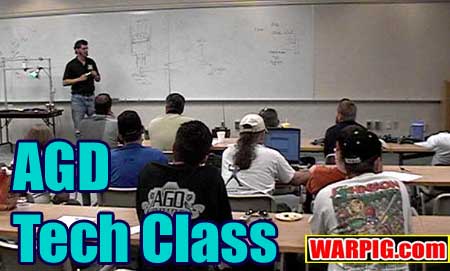
Airgun Designs Tech Class by Bill Mills As a pre-event to the 2003 DraXxus International Amateur Open, AirGun Designs hosted the 2003 AGD Tech Class. In the mid 1990s, AGD and Worr Game Products were the two companies in paintball providing airsmith training for their products. AGD’s tech class was held at their facility near Chicago Illinois. After a break of a few years with no training, AGD teamed up with WGP and other groups to provide a series of seminars together, and eventually settled on training before the IAO, as the tie in to a major tournament and industry conference made travel easier for shop owners, airsmiths and Automag enthusiasts.
After lunch, the class went into new areas, including what the company is currently developing, the ULE trigger. ULE stands for Ultra Light Engineering, and has been applied to some of AGD’s newer products including the ULE body and valve body, which are slim, lightweight aluminum components that replace the company’s earlier stainless steel models. Up until Airgun Designs released the Level 10 bolt kit, bolt pressure was a major factor determining the weight of the trigger pull in their mechanical guns. The Level 10 bolt kit uses a similar concept of varying piston diameters to greatly reduce the forward force of the Automag’s bolt, to the point that it is light enough to back off of a misfed paintball rather than chopping it. With the bolt force taken out of the trigger equation, AGD concentrated on the other item that effects trigger pull – the on/off valve.
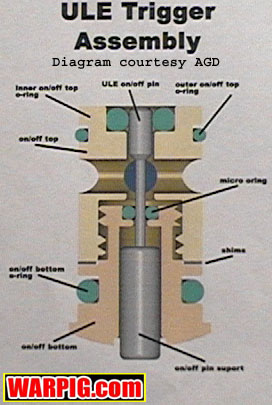
During the discussion, Kaye talked about the parts in the ULE trigger assembly, down to the micro o-ring that was small enough to seal against the very slender pin. That o-ring is made of black rubber. “Sure, we’d prefer to use a urathane o-ring there, but they don’t make them that small,” he said. Kaye explained that with proper installation and adjustment the Level 10 bolt combined with the ULE trigger assembly yielded a trigger pull as light or lighter than many electronic paintguns on an Automag with no electronics, and still having the benefits of a reactive trigger. It was Level 10 bolt that made the ULE trigger possible, Kaye said, because the lighter bolt pressure meant it was possible to use the new valve that pushed back on the sear with less force. The ULE trigger assembly was not slated for display or release at the Amateur Open, or available to dealers, but rather was supplied to the students trained in the tech class. AirGun Designs decided to use the techs who were newly and properly trained in the installation and operation of the new valve assembly to serve as its field testers. The company would then move forward with design changes or product release based on the feedback from that group.
|
| Copyright © 1992-2019
Corinthian Media Services. WARPIG's webmasters can be reached through our feedback form. All articles and images are copyrighted and may not be redistributed without the written permission of their original creators and Corinthian Media Services. The WARPIG paintball page is a collection of information and pointers to sources from around the internet and other locations. As such, Corinthian Media Services makes no claims to the trustworthiness or reliability of said information. The information contained in, and referenced by WARPIG, should not be used as a substitute for safety information from trained professionals in the paintball industry. |
 The
full day course started at 9:00 am, and ran into the night. The morning
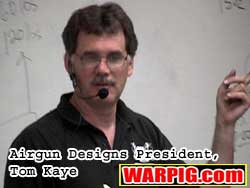
session focused on trigger dynamics. AGD President Tom Kaye defined
terms relating to the trigger pull including pre travel, hysteresis, and
post travel, especially focusing on how they relate to AGD’s Automag line.
The class also went into the details of adjusting the magnetic trigger
of the E-Mag.
The
full day course started at 9:00 am, and ran into the night. The morning
session focused on trigger dynamics. AGD President Tom Kaye defined
terms relating to the trigger pull including pre travel, hysteresis, and
post travel, especially focusing on how they relate to AGD’s Automag line.
The class also went into the details of adjusting the magnetic trigger
of the E-Mag.
 Automag
paintguns (regardless of model) are operated by a rocker sear. The
sear holds the bolt in the rear position, and closes the gun’s on/off valve.
When the trigger is pulled (or when the electronics trigger the solenoid
on the electronic ‘mag models) the front of the sear releases the valve
which blows forward under air pressure, and the rear of the sear closes
the on/off valve which closes off the rear of the air accumulator allowing
just the air in the accumulator to be used to propel the paintball.
It is the pressure of air from the ‘gun’s regulator which pushes the on/off
valve pin back out, pushing the front of the sear in position to hold the
bolt back, and returning the trigger to the front position at the end of
the firing cycle.
Automag
paintguns (regardless of model) are operated by a rocker sear. The
sear holds the bolt in the rear position, and closes the gun’s on/off valve.
When the trigger is pulled (or when the electronics trigger the solenoid
on the electronic ‘mag models) the front of the sear releases the valve
which blows forward under air pressure, and the rear of the sear closes
the on/off valve which closes off the rear of the air accumulator allowing
just the air in the accumulator to be used to propel the paintball.
It is the pressure of air from the ‘gun’s regulator which pushes the on/off
valve pin back out, pushing the front of the sear in position to hold the
bolt back, and returning the trigger to the front position at the end of
the firing cycle.
 A
few months before the tech class, AGD had demonstrated a product it was
developing, the ULE trigger. The ULE trigger assembly consists of
a replacement for the Automag’s on/off valve assembly. Kaye spent
over an hour discussing the basics of leverage and hydraulic principles
in order to explain how air pressure on the top of the on/off valve pin
affects the length and weight of the Automag trigger pull. The top
of the valve pin seals against an o-ring as the pin just makes contact
with the ring. When the ‘mag is at rest between shots, and the air
chamber is charging, a second o-ring further down on the pin creates a
seal to prevent air from leaking out of the ‘gun. The ULE trigger
assembly is an all new on/off valve in which the diameter at the head of
the pin is similar to a normal ‘mag on/off but the center of the pin is
only 0.035” in diameter. The result is that while the valve is open
at rest (with the trigger forward) the effective diameter of the piston
is very small (about as wide as 10 human hairs according to Kaye).
The resistance provided to the trigger is less than one pound, since the
surface area facing gas pressure is so small. However, once the trigger
pull is completed, the larger top of the pin seals, and is able to press
back, resetting the sear and trigger with as much force as a normal Automag
trigger.
A
few months before the tech class, AGD had demonstrated a product it was
developing, the ULE trigger. The ULE trigger assembly consists of
a replacement for the Automag’s on/off valve assembly. Kaye spent
over an hour discussing the basics of leverage and hydraulic principles
in order to explain how air pressure on the top of the on/off valve pin
affects the length and weight of the Automag trigger pull. The top
of the valve pin seals against an o-ring as the pin just makes contact
with the ring. When the ‘mag is at rest between shots, and the air
chamber is charging, a second o-ring further down on the pin creates a
seal to prevent air from leaking out of the ‘gun. The ULE trigger
assembly is an all new on/off valve in which the diameter at the head of
the pin is similar to a normal ‘mag on/off but the center of the pin is
only 0.035” in diameter. The result is that while the valve is open
at rest (with the trigger forward) the effective diameter of the piston
is very small (about as wide as 10 human hairs according to Kaye).
The resistance provided to the trigger is less than one pound, since the
surface area facing gas pressure is so small. However, once the trigger
pull is completed, the larger top of the pin seals, and is able to press
back, resetting the sear and trigger with as much force as a normal Automag
trigger.
 After
dealing with the ULE trigger assembly the class moved on to details of
the Level 10 bolt kit, dealing with its theory of operation as well as
how to adjust it, and moved on covering general maintenance techniques,
more operational theory, and new products such as AGD’s new “Y-Grip,” a
grip frame with a reverse angle, but much closer to vertical than the company’s
original “Z-Grip” frame designed to be ergonomically held with an arm reaching
from underneath the gun while sitting in a bunker. The
class also went into regulator recharge and flow rates, and what effect
they have on various paintguns. This included how the simple popet
valves in low cost blowback paintguns, and some of the more advanced electros
use air pressure to close, acting as a regulator to compensate for air
pressure changes. Popet valves were compared to dump chamber designs,
and the pros and cons of each were compared as to how each would depend
on fast reacting regulators to recharge, as well as maximum potential rates
of fire. The class officially ended at four o'clock, but continued
on with small discussion groups, and Kaye lecturing on topics such as the
problems manufacturers face dealing with the inconsistencies and lack of
"perfectness" in o-rings. The class’s break sessions and overtime
were a time for socializing, as most of the students knew each other from
After
dealing with the ULE trigger assembly the class moved on to details of
the Level 10 bolt kit, dealing with its theory of operation as well as
how to adjust it, and moved on covering general maintenance techniques,
more operational theory, and new products such as AGD’s new “Y-Grip,” a
grip frame with a reverse angle, but much closer to vertical than the company’s
original “Z-Grip” frame designed to be ergonomically held with an arm reaching
from underneath the gun while sitting in a bunker. The
class also went into regulator recharge and flow rates, and what effect
they have on various paintguns. This included how the simple popet
valves in low cost blowback paintguns, and some of the more advanced electros
use air pressure to close, acting as a regulator to compensate for air
pressure changes. Popet valves were compared to dump chamber designs,
and the pros and cons of each were compared as to how each would depend
on fast reacting regulators to recharge, as well as maximum potential rates
of fire. The class officially ended at four o'clock, but continued
on with small discussion groups, and Kaye lecturing on topics such as the
problems manufacturers face dealing with the inconsistencies and lack of
"perfectness" in o-rings. The class’s break sessions and overtime
were a time for socializing, as most of the students knew each other from