  |
|
 HomePicturesTechnicalTournamentRecreationalFieldsStores HomePicturesTechnicalTournamentRecreationalFieldsStores |
|
|
Beginner InfoNews
And ArticlesLinksResourcesVideoContact
UsSearch |
| |
|
|
HomePicturesTechnicalTournamentRecreationalFieldsStores |
|
|
Beginner InfoNews
And ArticlesLinksResourcesVideoContact
UsSearch |
What
do you think?
|
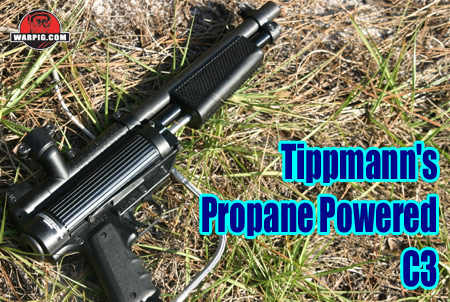
Tippmann C3 By Bill Mills - Photos by Dawn Mills - Dec 2005 Overview - How It Works - Disassembly - Testing - Raw Test Data
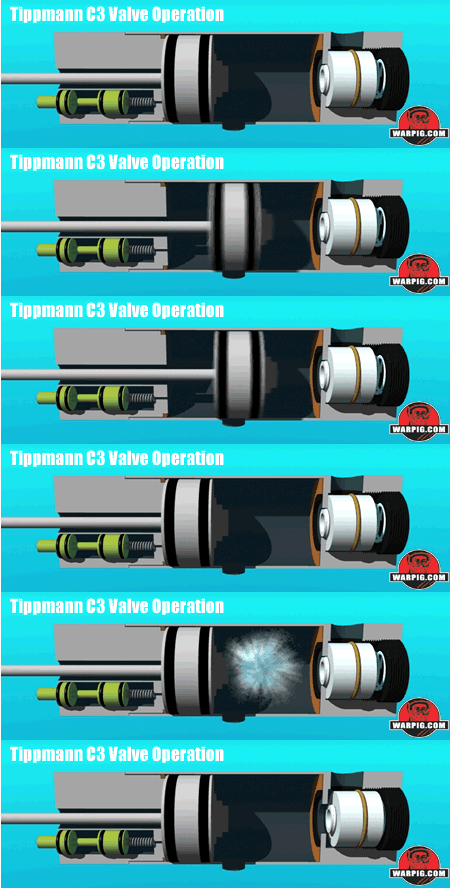
How It Works Understanding how the C3 works all comes down to the loading and firing sequence.
Gas grills commonly use piezoelectric spark generators as their ignition source. While the C3’s electronic ignition may be more complex, and require a battery, it has a number of advantages. Immediately noticeable to the player is the short microswitch defined trigger pull. The C3 design team cites their main reason for going electronic was reliability, and this is two fold. The electronic ignition has only one moving part, which does not see much stress – the microswitch. This reduces the chance of a mechanical failure. The electronic circuit can also fire more than one spark with each trigger pull. If the first spark doesn’t manage to ignite the fuel/air mixture, the one after it, or the one after that will. This ensures on field reliability.
As the fuel/air mixture combusts, the expanding pressure front of hot exhaust gasses can’t go out through the holes in the main piston – they are blocked, and it can’t escape via the air intake holes either, as they are blocked by the rubber ring. The remaining place for gas pressure to escape from the combustion chamber is by pressing back on a spring-operated piston at the rear of the gun. This rear piston controls the velocity, and Tippmann simply calls it the piston.
When the combustion gasses push the piston back, they open up a pathway through which they can flow upward through a passage into the back of the barrel. From there they enter the bolt, and further expand propelling the paintball out of the barrel. The piston is key to the C3’s operation. When the velocity adjustment screw is turned inward, it puts more spring pressure on the piston. This in turn means that the piston pushes harder against the exhaust gasses, and doesn’t open as far. It takes longer for the exhaust gasses to flow through the tighter space, resulting in a lower velocity shot. When the velocity adjuster screw is backed out, there is less pressure, the piston opens further, and higher velocities are achieved. Four staggered holes on each side of the receiver act as a safety relief. If the pressure on the piston from its spring were too weak to limit the velocity properly, piston would push back further, and gas would be vented out of these holes. This acts as a safety limiter preventing the C3 from being cranked up to excessive velocities. Because the velocity is adjusted by
limiting flow of exhaust gasses after combustion, velocity setting has
no effect on the amount of gas used to fire each shot – efficiency remains
the same at 220 fps as it does at 280 fps.
Continue to Disassembly |
| Copyright © 1992-2019
Corinthian Media Services. WARPIG's webmasters can be reached through our feedback form. All articles and images are copyrighted and may not be redistributed without the written permission of their original creators and Corinthian Media Services. The WARPIG paintball page is a collection of information and pointers to sources from around the internet and other locations. As such, Corinthian Media Services makes no claims to the trustworthiness or reliability of said information. The information contained in, and referenced by WARPIG, should not be used as a substitute for safety information from trained professionals in the paintball industry. |

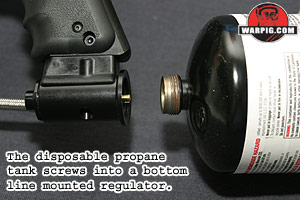 The
propane tank on the C3 screws into a bottom-line mounted regulator.
The regulator restricts the flow of gas to feed the C3’s fuel injector
valve a supply at about 40 psi. The regulator is adjustable, and
its setting will affect how lean or rich the fuel/air mixture is in the
C3’s combustion chamber.
The
propane tank on the C3 screws into a bottom-line mounted regulator.
The regulator restricts the flow of gas to feed the C3’s fuel injector
valve a supply at about 40 psi. The regulator is adjustable, and
its setting will affect how lean or rich the fuel/air mixture is in the
C3’s combustion chamber.
 The
firing sequence begins when the C3 is pumped. Pulling the pump back
pulls the bolt back allowing a paintball to drop into the breech while
also pushing the gun’s piston into its combustion chamber. The piston
is somewhat like the piston in an automobile engine in that it clears gasses
out of the cylinder, and pumps fuel and air into it, but unlike a car engine
the C3’s piston is not pushed by the internal combustion forces.
Instead the resulting gas pressure is used to drive a paintball out of
the barrel. Much like an automotive piston, the C3’s piston has rings
on it to allow it to seal to the walls of the combustion chamber.
Tippmann calls this piston the exhaust piston.
The
firing sequence begins when the C3 is pumped. Pulling the pump back
pulls the bolt back allowing a paintball to drop into the breech while
also pushing the gun’s piston into its combustion chamber. The piston
is somewhat like the piston in an automobile engine in that it clears gasses
out of the cylinder, and pumps fuel and air into it, but unlike a car engine
the C3’s piston is not pushed by the internal combustion forces.
Instead the resulting gas pressure is used to drive a paintball out of
the barrel. Much like an automotive piston, the C3’s piston has rings
on it to allow it to seal to the walls of the combustion chamber.
Tippmann calls this piston the exhaust piston.
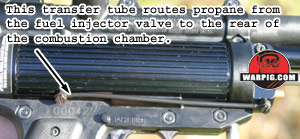
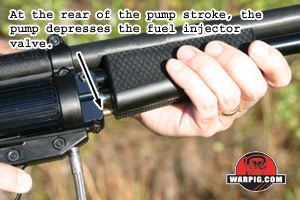
 When
the exhaust piston is pushed into the chamber, a series of air vents ringing
its center allow the exhaust gasses from the last shot to flow through
it. When the pump is pulled to the rear of its stroke, it presses
into a brass button on the front of the receiver. This button is
the fuel injector valve. As the pump activates it, the fuel injector
allows a small amount of propane to flow from the fixed output regulator
in the bottom of the grip frame through the injector valve, and out a fitting
on the side of the marker. From the gas fitting, the puff of propane
is routed by a thin flexible hose down the side of the C3, and into the
back end of the combustion chamber.
When
the exhaust piston is pushed into the chamber, a series of air vents ringing
its center allow the exhaust gasses from the last shot to flow through
it. When the pump is pulled to the rear of its stroke, it presses
into a brass button on the front of the receiver. This button is
the fuel injector valve. As the pump activates it, the fuel injector
allows a small amount of propane to flow from the fixed output regulator
in the bottom of the grip frame through the injector valve, and out a fitting
on the side of the marker. From the gas fitting, the puff of propane
is routed by a thin flexible hose down the side of the C3, and into the
back end of the combustion chamber.
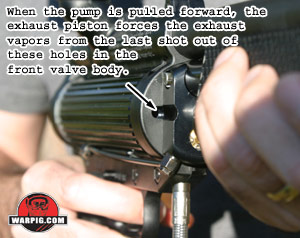
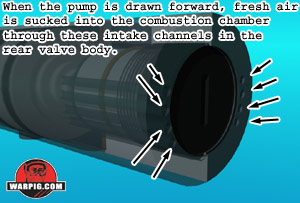 As
the pump is pulled forward, one-way valves in the piston seal it, and the
piston pulls the propane into the main area of the combustion chamber.
This pushes the old exhaust fumes that were in front of the piston out
a pair of vent holes in the front of the receiver. Also drawn into
the chamber is fresh air, coming in from eight channels drilled through
the back of the receiver. At the same time the piston is moving,
the pump is also moving the bolt forward, pushing a paintball forward in
the barrel, and sealing the breech.
As
the pump is pulled forward, one-way valves in the piston seal it, and the
piston pulls the propane into the main area of the combustion chamber.
This pushes the old exhaust fumes that were in front of the piston out
a pair of vent holes in the front of the receiver. Also drawn into
the chamber is fresh air, coming in from eight channels drilled through
the back of the receiver. At the same time the piston is moving,
the pump is also moving the bolt forward, pushing a paintball forward in
the barrel, and sealing the breech.
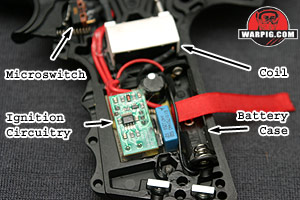 When
the C3 is at rest, ready to fire, the propane and air mixture remains in
the combustion chamber. It does not flow out because it is at atmospheric
pressure, and the holes through which the air entered are blocked by a
flexible rubber like one-way seal. When the trigger is pulled, it
activates a microswitch, which in turn sends a signal to the gun’s electronic
circuits. The circuits control a rather substantial coil that generates
a high voltage spark inside the combustion chamber. The spark ignites
the propane and air mixture which undergoes a small, controlled explosion.
When
the C3 is at rest, ready to fire, the propane and air mixture remains in
the combustion chamber. It does not flow out because it is at atmospheric
pressure, and the holes through which the air entered are blocked by a
flexible rubber like one-way seal. When the trigger is pulled, it
activates a microswitch, which in turn sends a signal to the gun’s electronic
circuits. The circuits control a rather substantial coil that generates
a high voltage spark inside the combustion chamber. The spark ignites
the propane and air mixture which undergoes a small, controlled explosion.
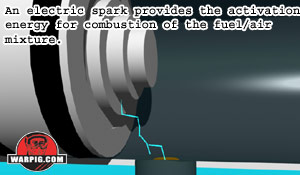 Each
time the trigger is pulled, not just one spark is generated, but a series
of sparks in rapid succession over about ¾ of a second. Each
of these sparks, is a 20,000 volt electrical charge jumping through the
air – all generated from a tiny 1.5 volt AAA battery.
Each
time the trigger is pulled, not just one spark is generated, but a series
of sparks in rapid succession over about ¾ of a second. Each
of these sparks, is a 20,000 volt electrical charge jumping through the
air – all generated from a tiny 1.5 volt AAA battery.
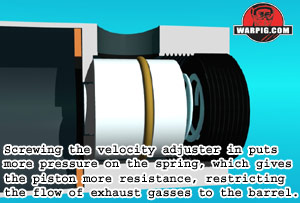 The
piston is forced into its closed position by a spring, which holds it forward.
The spring in turn is kept under pressure by a threaded end cap, which
Tippmann calls the velocity adjuster screw. The velocity adjuster
screw can be turned inward to increase pressure on the piston, or out to
decrease pressure.
The
piston is forced into its closed position by a spring, which holds it forward.
The spring in turn is kept under pressure by a threaded end cap, which
Tippmann calls the velocity adjuster screw. The velocity adjuster
screw can be turned inward to increase pressure on the piston, or out to
decrease pressure.